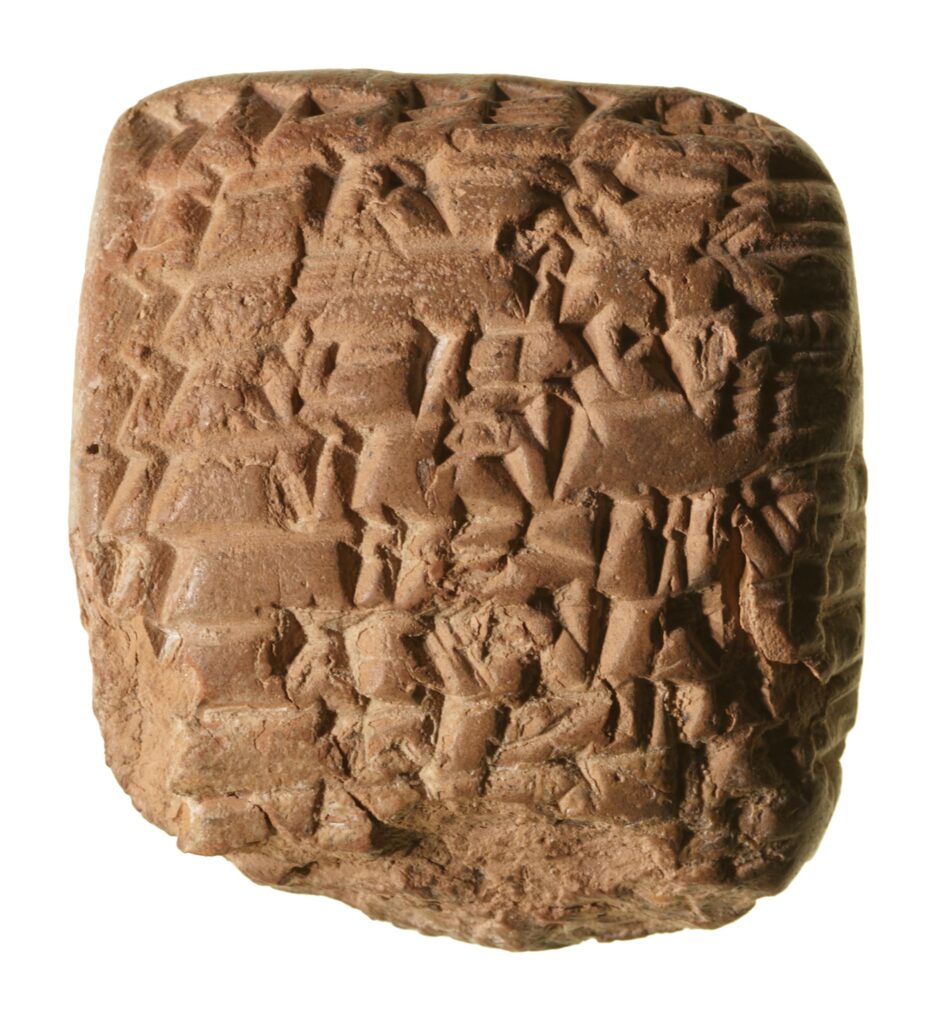
Akkadian cuneiform clay tablet. Source: The Letterform Archive / Wikimedia Commons (public domain).
Proto-Semitic is usually dated to 6000BC as a branch of Proto-Afroasiatic, itself dated to12000 to 8000BC. Proto-Indo-European, meanwhile, the source of most European languages, only goes back to about 3500BC. Alan Bomhard and others have promoted a common parent to both of these proto-languages called Nostratic, spoken in the area of Syria around 13000BC at the end of the Ice Age. He has presented more than 850 roots with numerous derivatives in a wide range of languages.
Comparing Pronouns Across Proto-Languages
Pronouns tend to belong to the most ancient layer of vocabulary, and if we compare the reconstructed proto-forms, we can find surprising similarities:
| Proto-Afroasiatic | Proto-Indo-European | ||||
|---|---|---|---|---|---|
| Sg 1. *ǝV- | Pl 1. *nV+pl | Sg 1. *egoH /*me | Pl 1. *wei /*n-s-me /*nos | ||
| 2. *tV- | 2. *tV+pl | 2. *ti /*te | 2. *yus /*u-s-me /*wos | ||
| 3. *sV- | 3. *sV+pl | 3. *so (that) | 3. *toy (those) | ||
PIE developed separate subject and object or oblique stems. In the 1st sg *egoH we have three components: e (this), g(h)e (indeed) and oH (copied from the verb ending), ie this very one, I. We can compare the PIE sg *e-,* t-, *s- with the PAA *ǝ-, (Ancient Egyptian has suffixed -i, while Akkadian and Hebrew have prefixed a-: the independent pronoun has added elements), *t-, *s-, and 1st pl *n- with PIE *nos etc. In the 2nd pl, PIE preserved the deictic element *u, so that, along with *e, it continued to use two of the very ancient demonstrative triad: *e/i = this, *u/o = that nearby, *a = that yonder, in which the size of the mouth cavity represents the distance from the speaker (small to large). Such a system of iconic particles could well predate homo sapiens. The demonstrative *to competed with *so in PIE and may ultimately have the same origin as 2nd person *t-, and I wonder if *wei is *u with added proximate *e/i.
Person Markers on the Verb
The similarity in pronoun stems carries over into person markers on the verb. We can take the Akkadian verb parāsum = to divide as an example for early Semitic:
| Active (preterite, prefix conj) | Stative (suffix conj) | ||
|---|---|---|---|
| Sg 1. a-prus | Pl 1. ni-prus | Sg 1. parsā-ku | Pl 1. parsā-nu |
| 2. ta-prus | 2. ta-prus-ā | 2. parsā-ta | 2. parsā-tunu |
| 3. i-prus | 3. i-prus-ū | 3. paris | 3. pars-ū |
Only the masculine forms have been given for simplicity. -ā and -ū are plural markers as may be the n in -tunu. These two tenses correspond to the Hebrew imperfective / future and perfective tenses respectively. How a perfective preterite tense became an imperfective tense in Hebrew is another story. Now compare:
Reconstructing the Proto-Indo-European and Proto-Nostratic Endings
| Proto-Indo-European | |||
|---|---|---|---|
| Active (Ergative) | Stative (Absolutival) | ||
| Sg 1. *-m | Pl 1. *-me | Sg 1. *-h2 | Pl 1. *-we |
| 2. *-s | 2. *-te | 2. *-t | 2. *-dhe |
| 3. *-t | 3. *-nt | 3. *-Ø | 3. *-Ø (later *-r(s)) |
with Bomhard’s reconstructed forms for Proto-Nostratic:
| Proto-Nostratic | |||
|---|---|---|---|
| Active | Stative (sg only) | ||
| Sg 1. *-mi, *-na | Pl 1. *-ma+pl, *-na+pl | Sg 1. *-kha, *-Ha | |
| 2. *-thi, *-si, *-ni | 2. *-thi+pl | 2. *-thi | |
| 3. *ša/šǝ, *na/ni | 3. *ša/šǝ+pl, *na/ni+pl | 3. *-Ø | |
How the System Might Have Evolved
Some comments should be made:
- I believe the 3rd person active in PAA was earlier treated as a noun and so could take case endings. If the Nostratic 3rd person stative with zero ending came to be regarded as a nominal form, noun case endings could then have been added, eg if we take the Akkadian root prus in i-prus = he divided, imagine that this root were originally the unmarked 3rd sg stative, which, treated as a noun, could have various inflexions: *prus-ī (ergative: it is likely that PAA went through an ergative phase), *prus-u (nominative, perhaps originally also ergative), *prus-a (accusative, perhaps originally absolutive). To create eventive counterparts to these stative forms, the agent/subject affixes might have been prefixed instead, giving: i-prus and *u-prus (cf Akkadian D stem u-parras). Once these 3rd person forms had become established, formerly suffixed 1st and 2nd p forms would have started to be prefixed as well. (We could imagine the original suffixed forms in the sg to have been *prus-a, *prus-ta, *prus-sa. Obviously the 3rd sg *prus-sa (too similar to the 1st sg *prus-a?) must have been displaced by the new form i-prus. If the 1st sg -a/a- were originally *ana, this could be the demonstrative *a of the same origin as the *e- in PIE *egoH2, plus 1st person -na in the chart above).
- In the stative there was no object and the subject was not seen as an agent, as in: I am asleep, it is separate etc. Thus there was no person marker in the 3rd person stative in PIE or PAA.
- In the PIE active, the 2nd and 3rd sg endings swapped places. Andreas Willi suggests that an optional demonstrative *-t (as in *to) started to be added to the zero 3rd sg stative, giving: 1. *-h2, 2. *-t, 3. *-Ø, *-t. To match the pattern -A, -B, -B, the active sg became: 1. *-m, 2. *-s, 3. *-s. Of course this meant that the 2nd and 3rd persons were no longer distinguished, so the *-s got reinterpreted as exclusively 2nd person and *-t as exclusively 3rd person. This meant the optional *-t in the 3rd sg stative was no longer used, bringing it back to zero.
- 1st person *-m is restricted to Chadic (Hausa maa=we) and Cushitic (eg Hadriyya 1st sg suffix -ummo) in Afroasiatic, being replaced by *ǝV (probably from *e as in PIE *e-ge) and *nV (the stem of PIE *nos=we). The PIE *-h2 (perhaps pronounced like the ch in loch) probably goes back to *-k, as in PAA. PIE stative 1st pl *-we (related to *wei?) became restricted to the dual when that came into use, replaced by active *-me. I wonder if the 2nd pl *-dhe was originally just a variant of *-te (cf Sanskrit 2nd pl present -tha). Eventually the PIE stative endings were used to form the perfect tense on the one hand, and on the other became the thematic present -o conjugation (Latin rego, regis, regit) with all endings (except 1st sg *-o-h2) replaced with the active ones (cf -m presents like latin sum=I am and Greek didō-mi=I give).
Tense and Aspect in Semitic and PIE
One last thing I would like to mention regarding the verb is that with its two basic tenses, perfective and imperfective, Semitic remains similar to PIE in its earliest phase, where it also had only two similar tenses or aspects. Whereas in Semitic, the durative or imperfective was indicated by reduplicating the root, and the perfective by the simple root, it was exactly the other way round in PIE. Just like in Semitic, the imperfective (referring to any incomplete action) covered all those senses that would later evolve into many of the tenses we know in Greek, Latin etc: imperfect, future, subjunctive (was doing, will do, may do, let (him) do etc), just as the reduplicating perfective evolved into certain aorists and the perfect (by analogy).
If you would like to learn more about the history of PIE and to an extent of PAA, or would like to learn a Near Eastern language such as Hebrew, Aramaic, Ancient Egyptian or even Akkadian or Sumerian, please contact me on this site.