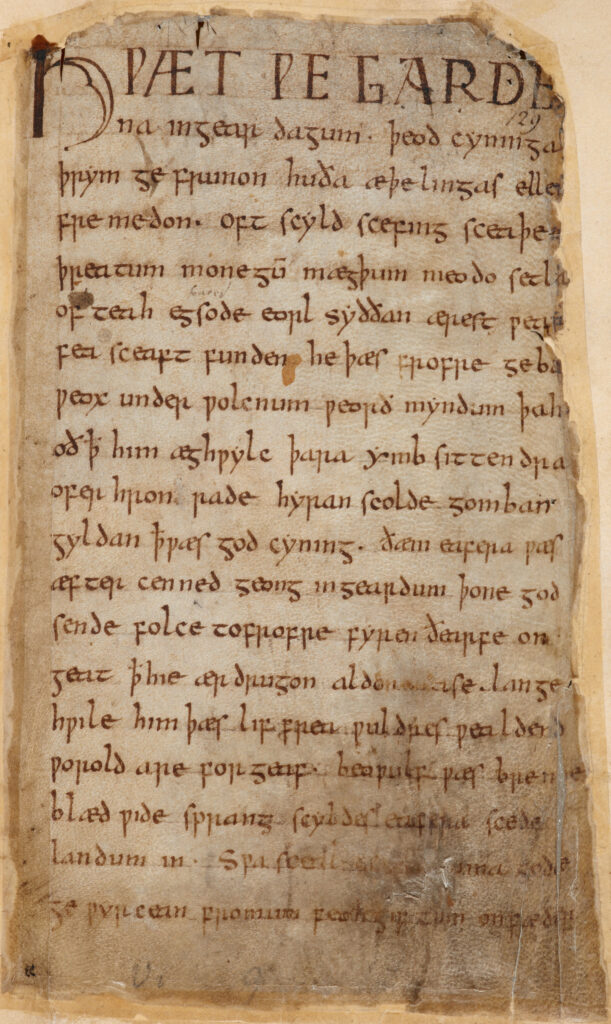
Beowulf, Cotton MS Vitellius A XV, f. 132r. British Library / Wikimedia Commons (public domain).
Old English, or Anglo-Saxon, was spoken from the time of the arrival of the Angol-Saxons into England in the 5th century until about 1100. Firstly it would be difficult to understand it spoken, because prior to the Great Vowel Shift of 1400 – 1700, vowels were ‘pure’ as in other European languages, so a e i o u were pronounced /a/ /e/ /i/ /o/ /u/, eg His wifes nama wæs Elisabeth /hiz wi:vǝs nama wæs elizabeϑ/. There were also split vowels, still written but no longer pronounced as such, eg dead, eorÞe (earth) and all consonants were sounded, eg cniht /knixt/ (knight).
A More Complex Grammar: Cases and Genders
Then the grammar was more complex. Nouns and pronouns had at least four cases and three genders, eg stān = stone (masc) had the following:
| Sg | Pl | |
|---|---|---|
| Nominative | stān | stānas |
| Accusative | stān | stānas |
| Genitive | stānes | stāna |
| Dative | stāne | stānum |
Feminine and neuter nouns were declined differently.
The definite article ‘the’ had even more distinct forms, eg in the masculine (Þ = th)
| Nominative | se |
| Accusative | Þone |
| Genitive | Þæs |
| Dative | Þæm, Þām |
| Instrumental | Þy, Þon |
Thus the nominative and accusative sg of stān could be distinguished when the article was added: se stān vs Þone stān (the stone)
Adjectives: Strong and Weak Endings
Adjectives had two sets of endings: strong when used alone with a noun, eg eald mann (old man) and weak when following a demonstrative, eg se ealda mann (the/that old man) or a possessive adjective, eg mīn ealda freond (my old friend). This was because a particularizing suffix -an was added to adjectives after grammatical words that specified particular individuals (-an + inflexion often atrophied to -a). We find this in other related languages, eg Latin has catus = shrewd vs caton- = the shrewd one.
The Verb: How ‘Sing’ Became Simpler
The verb also has four tenses: present and past indicative, and present and past subjunctive. Let’s look at the present indicative:
| Sg 1. | singe (I sing) |
| 2. | singest (you sing) |
| 3. | singeÞ (he/she sings) |
| Pl | singaÞ (we/you/they sing) |
Earlier the 2nd sg was simply singes without the final -t, so the endings -e, -es, -eth correspond with the Latin ones (end chart), eg rego (I rule), regis (you rule), regit (he/she rules). Some think the -t added later was a reduced form of ‘thou’, but there was also influence from modal forms such as ‘thou canst’, themselves influenced by the -t in ‘thou art’ which preserves an old perfect tense form. Now in the north of England where the -es form was retained longer, the verb came in contact with the Old Norse forms, eg
| Sg 1. | tel (I count) |
| 2. | telr (you count) |
| 3. | telr (he/she counts) |
(-r was originally -s), where the 2nd person form had taken over from the 3rd person. This pattern got copied into Northern and West Midland English, so
| Sg 1. | singe |
| 2. | singes |
| 3. | singes |
These forms reached London via migrants from the north from the 14th century on, and by the 16th century -s had replaced -eth in the 3rd sg, eg he goes. In uneducated speech, the -s extended to all persons and numbers, eg I goes, they goes, you was etc. With regard to the plural ending -aÞ, it goes back to *-anÞ, cf Latin regunt = they rule (n was lost before fricatives in West Germanic). It ousted the original 1st and 2nd pl endings still found in Old High German:
| Pl 1. nememēs (we take) |
| 2. nemet (you take) |
| 3. nemant (they take) |
The Subjunctive Mood
For the present subjunctive we get sg singe and pl singen. The plural came to be used as an indicative ending in Middle English. Many people are not aware that we still have a subjunctive in modern English, as in: ‘she asked that nobody arrive late’ with no -s on arrive. Rules for its use are similar to those for Latin.
Old English Literature
Old English literature covers a very wide range. In prose we have the Anglo-Saxon Chronicle, which details events year by year until 1154. King Alfred and others translated Latin works on education, philosophy and religion, including the Bible. There were homilies as well as prose fiction such as The Wonders of the East, scientific and medical writings, laws, charters and wills. In verse, there were poems treating heroic subjects such as Beowulf, historical poems such as The Battle of Maldon, biblical paraphrases, lives of the saints and religious poems such as The Dream of the Rood, short elegiacs and lyrics such as The Wanderer and The Seafarer, and riddles. Old English poetry has a distinctive style, written in alliterating half lines. Most noticeable is the use of highly imaginative compound words called kennings. A ship for example, might be referred to as a wægflota (wave floater), a sægenga (sea goer), a merehus (sea house), a sæhengest (sea stallion) or an ythmeard (wave horse). The sea itself might be called a swanrad (swan road) or a hwælweg (whale way). The human body is a banhus (bone house), the eye a heafodgim (head gem) and a sword is a beaduleoma (battle light). Let me finish with a couple of lines from Beowulf:
Wæs se grimma gæst Grendel haten
mære mearc-stapa se moras heold
fen ond fæsten
The grim spirit was called Grendel, well-known march haunter, he who held to the moors, the fen and the fastness.
If you’d like to study Old or Middle English and its literature (or another ancient Germanic language), please contact me.
Want to go deeper?
Nigel's course The History of English: An Introduction covers this in full — available as self-study or live online classes.