
Linear B tablet from the Palace of Pylos, 13th century BC. Photo: Gary Todd / Wikimedia Commons (CC0).
That would be Linear B, a form of Greek far older than the epics of Homer, the Iliad and the Odyssey, which are usually dated to the 8th century BC. This language was actually spoken by the Greek characters of the Iliad, Achilles and Agamemnon way earlier in the 12th century BC. It doesn’t use the familiar Greek alphabet, but rather a syllabary of pictographic style characters that these early Mycenaean Greeks probably borrowed from the Minoans of Crete or their predecessors, whose language is called Linear A and is still not yet deciphered.
Linear B: Greek Before the Alphabet
Here is a passage that I translated into Linear B during my time at Oxford. My favorite characters are the ones which seem to resemble humans. Each character represents a vowel or syllable, eg a e i o u or ka ke ki ko ku; ma me mi mo mu etc. Some characters remain undeciphered.
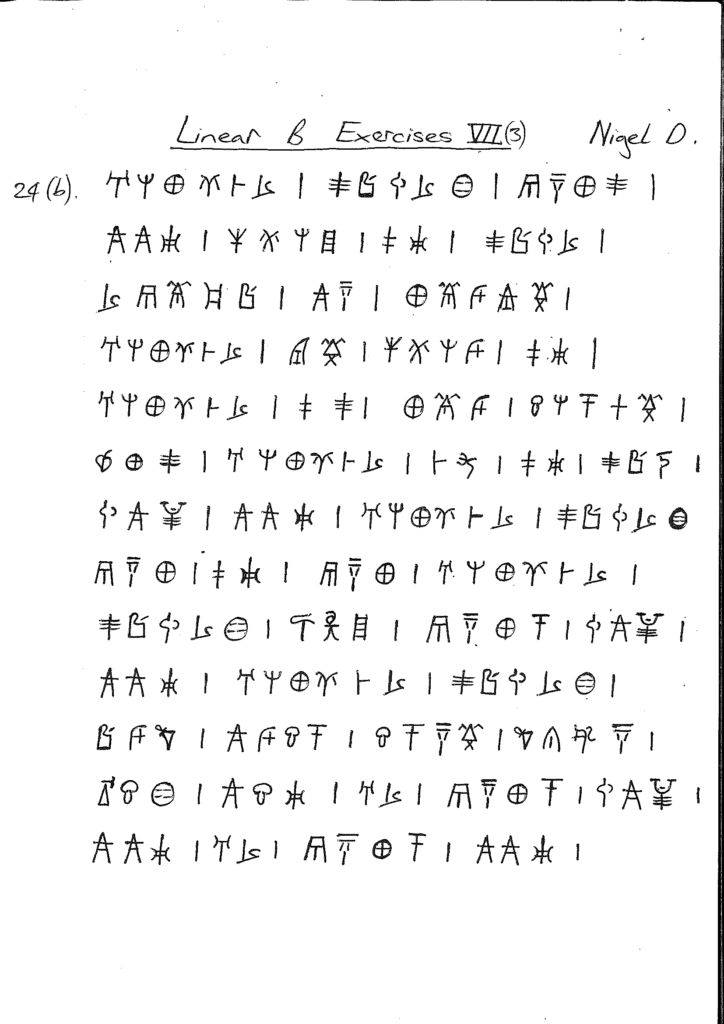
One of Nigel’s own Linear B translation exercises from his studies at Oxford.
A Script Not Built for Greek
It is clear the script was designed for another language, such as Linear A, as it is so highly unsuitable for Greek. The system only allows for sequences of CV, so that consonant clusters can’t be represented and word final consonants are ignored, eg ti-ri-po for tripous (tripod). Voiced / voiceless opposition and aspiration, so important in Greek, are ignored. So the k in ka ke ki ko ku can represent k kh or g and the p in pa pe pi po pu can represent p ph or b. Likewise the r in ra re ri etc can also represent l. There are no distinctions for vowel length. These simplifications reduce Greek to a bewildering mass of homograms: a-ko = ago, akos, algos, argos, archon, askos, angos etc. In some cases we can see older forms of Classical Greek words still in use, eg wanax for anax = lord, quasileus for basileus = king (or is it some other kind of official? – the text isn’t clear). The oldest confirmed inscriptions are from the Room of the Chariot tablets at the palace of Knossos in Crete (1400-1350 BC). (It seems the Mycenaean Greeks invaded Crete after the massive eruption at Thera). The latest are from Pylos in the Peloponnese around 1200 BC.
Palace Records from a Vanishing World
What did these early Greeks write? Certainly not literature. Writing served a much more practical purpose. It was used for keeping palace records – inventories, legal documents and the like. But these can tell us a lot about the society of the time. We find a recipe for producing perfumed ointments; a lease in which a priestess leases land to a slave woman in return for a portion of the produce; lists of chariot parts; and a record of a rather desperate sacrifice of gold vases and women to the goddess Posidaea and others, perhaps at the time when Pylos was about to be sacked and destroyed around 1200 BC. We know that the Dorians came south into the Peloponnese at this time, eventually overwhelming Mycenaean society. From the Dorians would emerge the famously militant Spartans. Many Ionians fled to what is now Turkey, while the Achaians fled to Cyprus. Only a small number remained in the mountainous centre of the Peloponnese, and they became known as the Arcadians, the butt of jokes about their backwardness.
To learn more about Linear B, or indeed Classical or New Testament Greek, please contact me on this site.
Want to go deeper?
Nigel's course Ancient Greek: An Introduction covers this in full — available as self-study or live online classes.