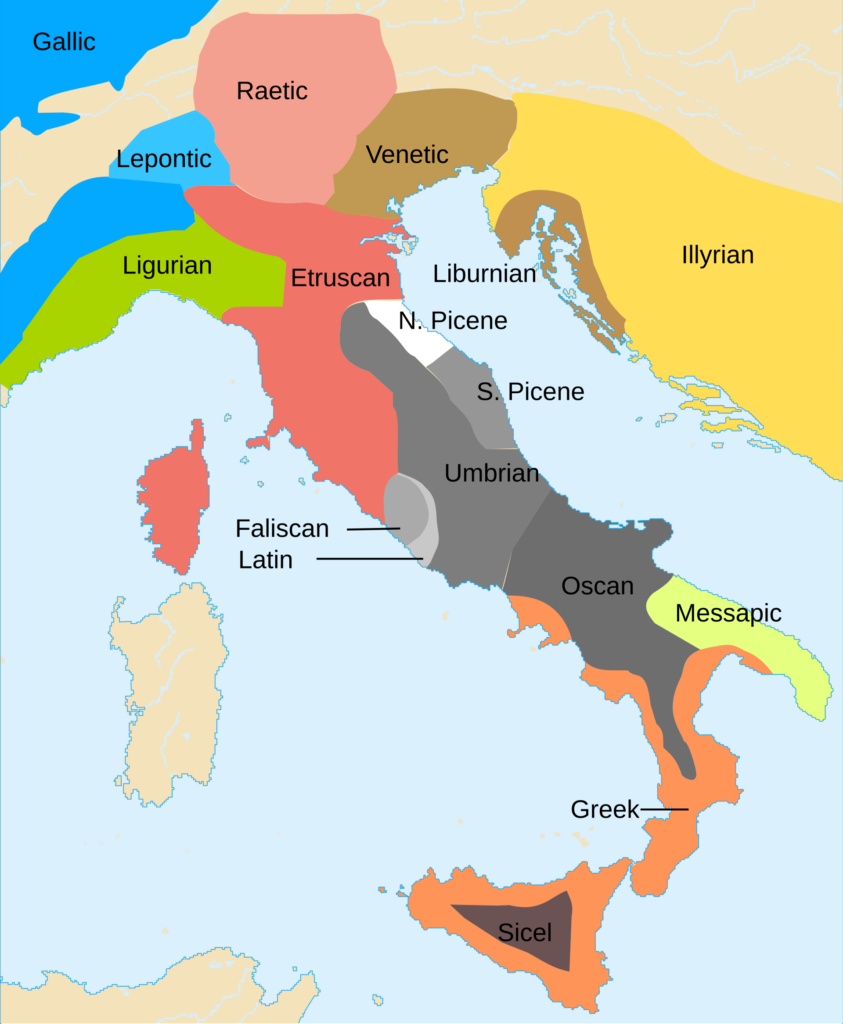
Languages of Iron Age Italy, c. 6th century BC. Map: Dbachmann, SVG by Ewan ar Born / Wikimedia Commons (CC BY-SA 3.0).
As you can see from the map, this was far from the case. Early on Latin and its close relative Faliscan was confined to a small area near Rome. Greek was spoken widely in the south, following the establishment of colonies there, and Etruscan, a language unrelated to any other except Rhaetic, in the north. Messapic was related to the languages of Illyria across the Adriatic Sea, where Albanian is now spoken. That leaves the Sabellic languages (South Picene, Umbrian and Oscan) which were related to Latin in the Italic branch of Indo-European. Sabellic speakers moved south before 1000BC, dividing into various groups and gradually occupied central and south Italy. The name Italy is probably of Oscan origin from viteliu = calf, so the Land of Cattle *Vitelia (Terra). This name was used by the Greeks to refer to Calabria and the far south before its extension to the whole peninsula. Viteliu (Latin vitulus) is related to Greek etos earlier *wetos = year, so strictly means a yearling. As might be expected, many place names in Italy have Oscan or Umbrian origins. Probably most famous is Pompeii, which in Oscan means “the five (villages)” from Oscan pompe = five. Latin quinque preserves the original qu- for p-. Presumably five villages banded together under one local government to form the urban centre we know so well. It may be that the Latino-Faliscans entered Italy first and were largely pushed out of the centre by Oscans and others at an early date. Some may have moved as far south as Sicily, where they established themselves as Sicel speakers. The Roman writer Varro states that the Sicel language was very close to Latin, as many words sounded identical and had the same meaning, eg oncia = uncia = twelth part, inch; lytra = lutra = otter.
Of course over time as the Romans took control of more and more of Italy, Latin started to take over. Umbrian was used till the 1st century BC and Oscan till the 1st century AD.
Comparing Oscan, Umbrian and Latin
It is fascinating to compare Oscan and Umbrian to Latin and see the similarities and differences. Firstly some bizarre sound changes. Voiced aspirates bh dh and gh become f not only word initially (as usually in Latin), but also word internally: Oscan: prufatted = he approved (Latin probavit < *pro bhu- = being in front), mefiaí = in the middle (Latin media <*medhiya-). As if this were not enough, the cluster -ns- became f much of the time as well. So we get Umbrian nerf < *ner-en-s, accusative plural of PIE *h2ner = man. Latin would be **nerones. Other examples are Oscan staef = standing < *sta-ens (Latin stans). Umbrian zeřef = sitting < *sedens (with added change d > rs). P for qu- has already been mentioned: hence Oscan paam for Latin quam. Noun endings retain older forms than Latin: feminine genitive singular -as found only in Latin paterfamilias = father of the household; ablative feminine singular -ād retains final -d found in Old Latin. PIE nominative masculine plural *-ōs < *-o-es has not been replaced with Latin -ī. The Latin perfect tense of the verb in -u/v is not found at all (in fact it is not even found in Faliscan, the closest relative of Latin). Instead we find a stem in -tt- in Oscan as quoted earlier in prufatted for Latin probavit.
Surviving Texts: The Cippus Abellanus and Iguvine Tablets
Finally I’d like to mention a couple of the longer texts that survive. For Oscan we have the Cippus Abellanus, a legal agreement between two towns to divide the ownership of a temple of Hercules into two parts, with a boundary line running right through the middle of the temple. For Umbrian we have the Iguvine Tablets, which relate a ceremony for purifying the citizen army. They are to walk around the citadel with fire brands, ritually calling out the banishment of their enemies. Please contact me if you’d like to learn more about Oscan and Umbrian and go through the texts.
Want to go deeper?
Nigel's course Latin: An Introduction covers this in full — available as self-study or live online classes.