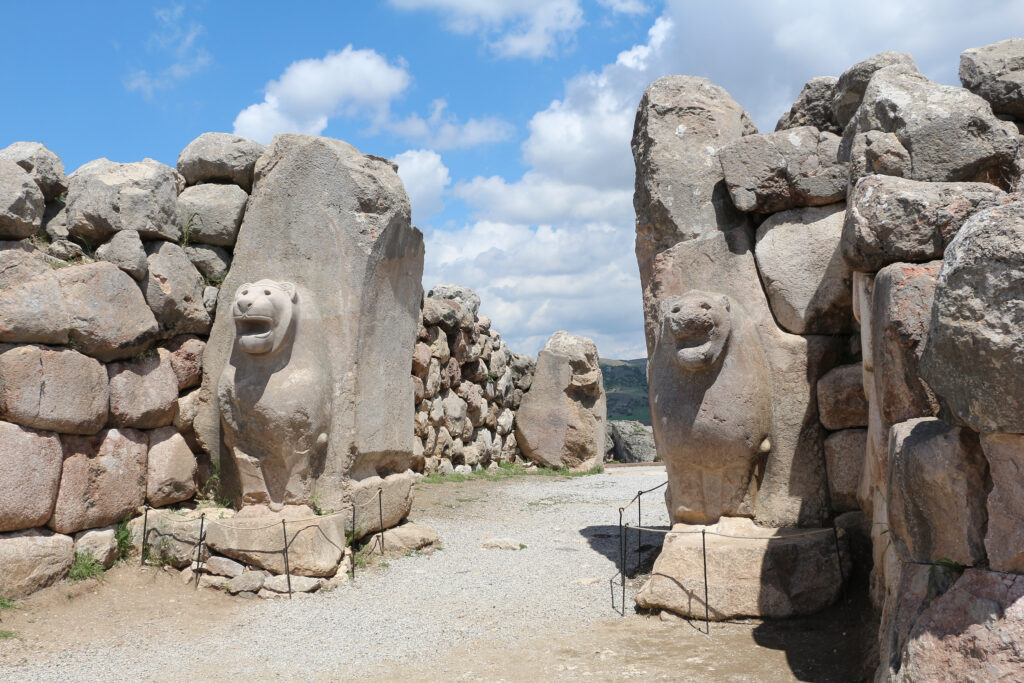
The Lion Gate at Hattusa, capital of the Hittite Empire. Photo: Bernard Gagnon / Wikimedia Commons (CC BY-SA 3.0).
You might think of Sanskrit, and indeed until the 20th century it was considered the oldest. But in 1902 two letters were found in Egypt called the Arzawa letters in a hitherto unknown language identified as IE. Then in 1906 the first large scale Hittite finds were made in the central Turkish village of Boǧazköy, some 90 miles east of Ankara. This turned out to be Hattuša, the capital of the Hittite kingdom. The tablets were found in the remains of a royal archive.
Discovering Hittite
During the 1st World War a Czech philologist deciphered the Hittite language and proved that it was IE. This and subsequent finds were dated from 1600 to 1200 BC., divided into the Old, Middle and Neo Hittite periods, ending with the invasion and destruction of Hattuša around 1200BC. At their height, the Hittites shared control of the Near East with the Egyptians. The two powers fought a major battle at Kadesh on the Orontes River in Syria around 1300BC, establishing the boundary between them.
A Cuneiform Script Borrowed from Assyria
Hittite was written using cuneiform, picked up no doubt from Assyrian merchants living at the trading colony of Kanesh in Anatolia. Wedges impressed on clay were combined to form three types of sign: to denote a phonetic syllable, eg an, na called syllabograms; to denote a word, eg god, transcribed by the Sumerian DINGIR = god in capitals. Such signs are called logograms or ideograms. Then there are determinatives, showing that the following word belongs to a certain class, transcribed by a superscript capital, eg D = class of gods. Sometimes Akkadian words were used for logograms, transcribed with italic capitals. All these elements give the appearance of a jumble of different languages, as if you said: “I, fils de Mursilis, was the Diener des Gottes”(I, son of Mursilis, was the servant of God). But it is likely that all the words were actually read as Hittite. Because it was a syllabary system (V, VC or CV), there appear to be many redundant letters when written out in Latin script: ma-ah-ha-an = when was probably pronounced /mahan/. If a vowel is repeated it likely indicates the word accent. If a consonant is repeated it shows it is voiceless, eg a-ap-pa = back, pronounced /ápa/ not /ába/. Appa, by the way, may have the same root as Greek apo = from (and English: of), which with its allative ending -o would originally have meant : in the direction of the back, away, or perhaps like the Hittite accusative form appan = towards (someone’s) back, behind, after.
The Hittite Verb: Two Tenses, Two Conjugations
Hittite has only two synthetic tenses: present and past/preterite (compared with as many as six in other IE languages). The present tense has both a -mi conjugation and a -hi conjugation. These are the markers of the 1st person sg and recall the Greek types in -mi and -o (also Latin sum = I am vs amo = I love). Both the -hi and -o forms may go back to PIE participles, with *-h2e-i ending added to the first and *-o-h2 added in the second case. The -hi ending demonstrates the continued use of IE laryngeals, which were lost everywhere else. 2nd and 3rd sg -si and -zzi match Greek present -si and -ti (Latin -s and -t), while -tti and -i are related to Greek (and more obscurely Latin) perfect endings. Plural -weni and -tteni show added particles (pl -n +-i). -we would be an alternative to -me which would later be coopted as a 1st dual ending elsewhere, while -te is found in Greek es-te = you pl are. The preterite mostly differs from the present in lacking the present marking particle -i (1st sg -un goes back to *-vocalic m). The main exception is the 3rd pl -er, where the -r is an old verbal noun marker, restricted to the 3rd pl very early on – seen in Sanskrit dadrśuh (-h = -r) = they saw and Latin perfect vīdērunt (earlier vīdēre) = they saw. This -r also becomes a marker of the Hittite mediopassive present tense with added -i, eg ar-ha-ri = I stayed cf ar-tat-ti = you stayed, perhaps with influence from the person marker -t. Latin also uses the -r as a passive marker, eg amātur = he is loved.
The Hittite Noun: An Archaic Case System
Turning our attention now to the noun, in particular the a-stems (PIE o-stems), we see the nominative and genitive sg -as (IE *-os) are still identical, without the relative particle *-yo added to the genitive as elsewhere (Greek -oio, Sanskrit -asya). However the genitive -as is distinguished from ablative -az, derived from *-oti. This preform may contain the same -t found in the instrumental with added particle -i = here/there (cf Old Latin -ōd and -ād). The dative and locative are undifferentiated as -i, and we have a case, the allative (-a < *-o(H)), indicating movement towards, which is only found in petrified form elsewhere (as in the Greek prepositions ap-o = from and hyp-o = under). The plural is still minimally developed: we have unique forms in -s for the nominative and accusative (-ēs and -us from PIE *-eiĕs and *-ns/ms), but no trace of the particles *bhi and *mi seen in Germanic, Greek, Latin and Sanskrit etc. The ablative sg -az doubles for the ablative pl and genitive/dative/locative -as may be a pl form of allative sg -a. Some believe the dative / ablative pl Latin -bus and Sanskrit -bhyah comes from *-bhi + allative pl *-os. There is no dual: perhaps Hittite split from the rest of the IE family before the dual was formed.
What Survives in Hittite
There are a wide range of documents surviving in Hittite, starting with the Old Hittite law code, which covers laws on murder, personal injury, family and witchcraft. We have myths: the Telepenus Vanishing God myth, proclamations of kings which give historical insight, a letter from King Tut’s widow to King Suppiluliumas, and many prayers and rituals, including a dedication ritual for a new building in which the gods are invited to dwell in its walls and doorways. If you’d like to learn more Hittite, or perhaps another ancient language, please contact me on this site.
Want to go deeper?
Nigel's course Indo-European and the Indo-Europeans covers this in full — available as self-study or live online classes.