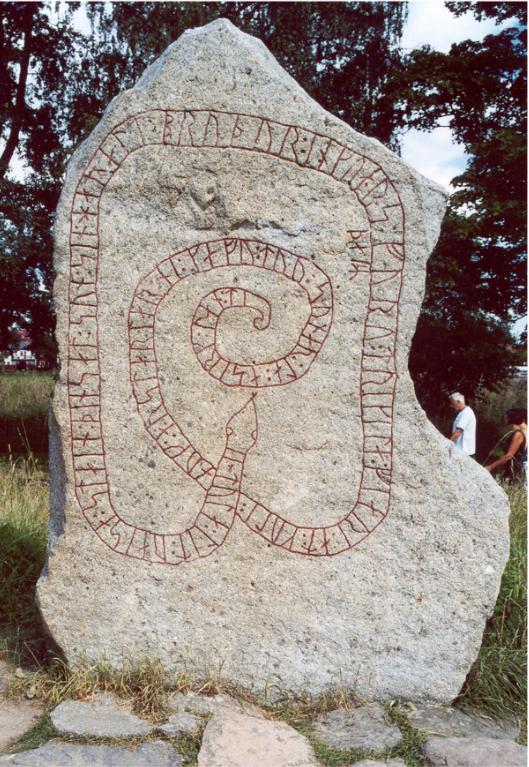
The Gripsholm runestone, Sweden. Photo: Tåggas / Wikimedia Commons (CC BY-SA 3.0).
The Germanic homeland was in Denmark, southern Sweden and Norway. The first Indo-European speakers were probably the Battle Axe Culture who arrived there in the 3rd millenium BC, mixing with earlier farmer migrants. A stable Nordic Bronze Age culture, in which high ranking individuals were buried in large mounds, flourished in the 2nd millenium BC. The Indo-European dialect they spoke evolved into a mature form of Proto-Germanic by 500BC.
From Proto-Germanic to Old Norse
In Scandinavia, it in turn evolved into Old Norse, and indeed the oldest known writing is in the form of Primitive or Proto-Norse runic inscriptions, dating from the 2nd c AD to 700AD. They are written on stone, or on more personal artifacts such as brooches or swords. The runic symbols have been linked to letters of north Italic alphabets, and initially comprised a set of 24 characters known as the Older Futhark (named after the first 6 signs), which was later reduced to 16 (the Younger Futhark).
Reading the Runestones
The Nœlving clasp dates to 200AD. It reads:
Bidawarijaz talgidai
= Bidawarijaz carved (this). Bida is related to English bide, Latin fidus = loyal, while warijaz (with nom sg -az < *-os) = protector, cf English war-d, so the name means Protector of the oath. The weak past 3rd sg verb ending -idai = idē, later Old Norse -đi and English -ed. It is said that the original suffix -da was a form of ‘do’. Elsewhere we get ek fah-ido = I painted,, showing the 1st sg weak past form.
Another fascinating inscription on a spear shaft from Denmark, dated to 300AD, reads:
Ek erilaz asugislas em uha haite auja gebū
= I am (ek em) the erilaz of Ansu-gislaz (gislaz = hostage, ansu = (of) the gods). I am called (hait-ē/ai = 1st sg present passive) Uha (= the High One). I give (gebu) protection (auja). Erilaz is usually connected with Old Norse jarl and English earl, and some see the root er- as linked to Old Norse ari = eagle, so ‘he of the eagle, eagle man”, perhaps some sort of shaman.
A final inscription I’d like to mention is on the Stentoften stone in Sweden (600-650):
Ni uhA borumz, ni uha gestumz… WelAduds sA ÞAt bAriutiÞ
= not Uha to the sons, not Uha to the guests … (in possession of) an insidious (welA) death (duds) (is) he who (sA) breaks (bAriutiÞ) this (ÞAt). Two things here: we see a familiar negative particle ni cf Old English ne, but in later Old Norse the negative was gi. This would derive from *kwid (cf Latin quid) as part of an emphatic negative phrase *ne … kwid = not at all. Secondly, we see the original 3rd p sg present ending -iÞ like OE -eth, as in “here endeth the lesson”. This would be replaced by the 2nd sg -r (itself from *-s) in classic ON, where the present tense goes as follows, using the verb telja = to count as an example:
| Sg tel | = I count | Pl teljum | = we count |
| telr | = you count | teliđ | = you count |
| telr | = he/she counts | telja | = they count |
From Runes to Parchment: The Icelandic Sagas
In the 12th century, runes, which had been carved on stone and wood, started to be replaced by alphabetic writing in Iceland, where parchment was now used. The family sagas, which had been passed down orally, now began to be written down. Iceland had only been first settled around 900AD, so its history was still relatively fresh in memory, so Icelanders must have felt a desire to record it for posterity. There was also the Sturlunga Saga, recording contemporary events of the 12th and 13th centuries, and the kings’ sagas, covering the history of Scandinavia. These were filled out with legendary tales, saints’ lives, knights’ sagas and tall tales.
Njal’s Saga
One of my favorites is Njal’s Saga, showing the breakdown of law and order in Iceland between 960 and 1020. As part of a blood feud, the house of the leading character, Njal, is burnt down with him and his wife in it. They lie down on their bed to await their fate, because, Njal says, he is too old to avenge his sons and he doesn’t want to live in shame. The text is shot through with dark humour, even when relating such grim circumstances. Old Norse literature is one of the most extensive surviving from the early medieval period. If you would like to study this language and its literature, please contact me on this site.
Want to go deeper?
Nigel's course The Viking Language: An Introduction covers this in full — available as self-study or live online classes.